
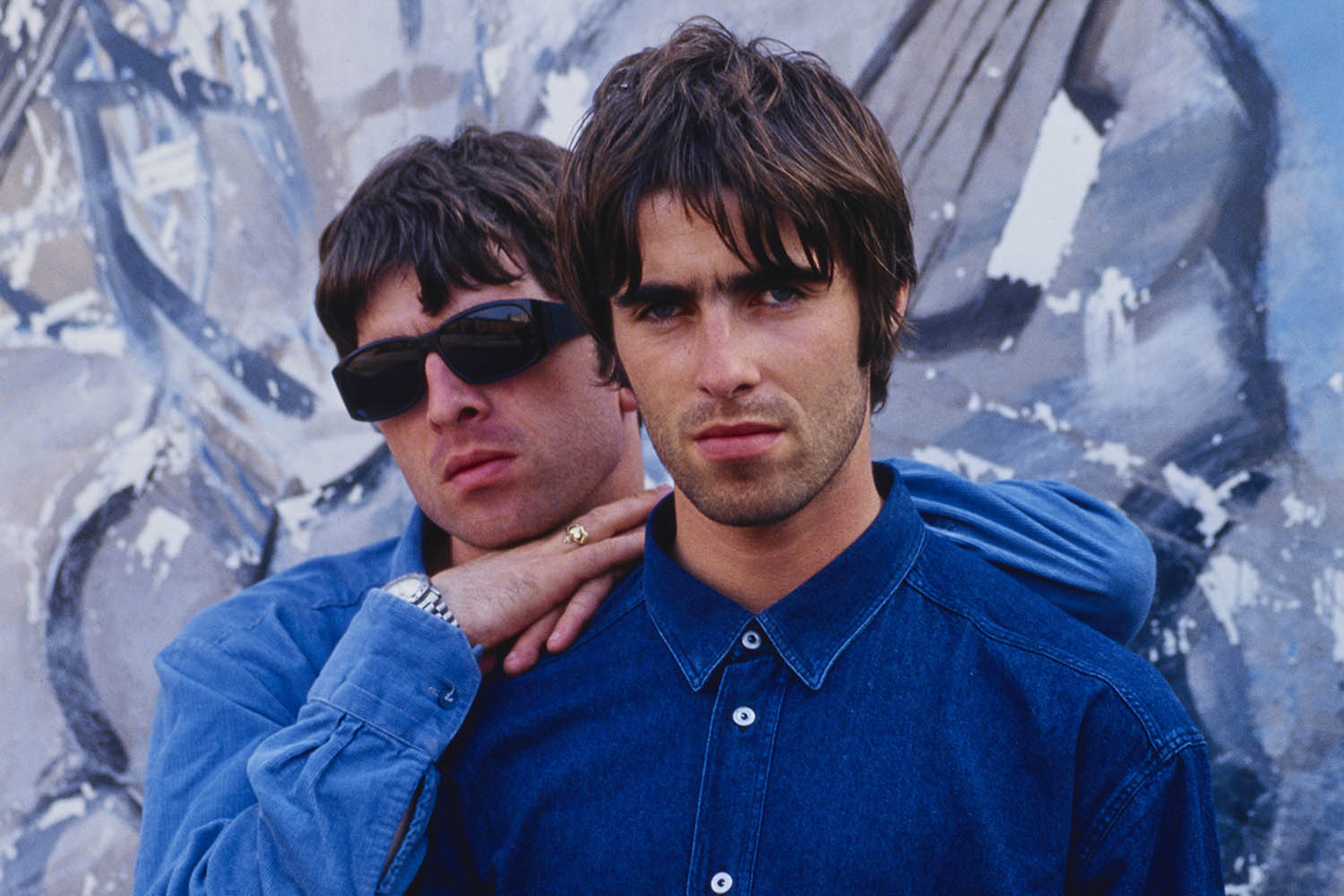
Last year, on 27 August, the end of a 15-year war was announced on social media. “The guns have fallen silent,” declared Oasis’s accounts, with no little bombast. “The stars have aligned. The great wait is over. Come see. It will not be televised.” On 4 July, a reunited Oasis will play the first of 41 scheduled gigs as a band once again, a hell-freezing-over scenario many fans doubted would ever happen, given the levels of rancour between the band’s frontman, Liam Gallagher, and his older brother, guitarist Noel. A lot of the fighting was public – “tofu boy”, “potato”, “former brother” and “a man with a fork in a world of soup” were some of the funnier barbs traded.
The senior Gallagher had been particularly unequivocal about the band being over. “If I was to get Oasis back together tomorrow and then do a tour, I’d have $100m in the bank but I’d have learnt fuck all,” Noel told Q magazine in 2017.
“If I had 50 quid left in my pocket, I’d rather go busking,” he told Mojo the following year.
Theories abound about the reasons for Noel’s change of heart. Some point to his split from his partner, Sara MacDonald, to whom he was married for 12 years. Liam’s need for his brother, meanwhile, was arguably at an all-time low. The younger Gallagher had played two sold-out gigs at Knebworth in 2022 as a solo artist and toured in 2024 to mark the 30th anniversary of Oasis’s Definitely Maybe – without the rest of Oasis.
Whatever the motivation, the floodgates have been opened on all things Oasis, dovetailing into a wider 1990s revival in which younger people, in particular, are looking back with envy at a time before phones had cameras.
These high waters carry upon them a number of books, two of which claim to have been in the works since before the reunion announcement: PJ Harrison’s Gallagher: The Fall and Rise of Oasis and A Sound So Very Loud: The Inside Story of Every Song Oasis Recorded by Ted Kessler and Hamish MacBain. In the latter we find Kessler – in 2016, as acting editor of Q – hanging out with Liam Gallagher, a man he had interviewed many times before, including for The Observer in 2002. In the pub, they’re dissecting the pre-release screening of Supersonic, the soon-to-be-released Oasis documentary. Liam has issues, but he can 100% endorse the bit where Noel compares himself to a cat and Liam to a dog.
“Without a doubt,” agrees Liam, getting into the kind of bullish, savant stride that sold millions of copies of music weeklies and men’s monthlies between 1994 and the internet age, and newspapers both tabloid and broadsheet. “He’s arrogant, sticks his arse up, comes and goes as he pleases, stands apart, just surveying everyone. Loves being stroked. Total tart. Loves you when he wants. I only get took out on a lead. I’m not allowed on the sofa. I run around with the pack, barking, tongue hanging out. He’s all aloof up there watching, licking himself and plotting. That’s us all right.”
Oasis were – are – a band that served as a kind of lightning rod for all sorts of binaries, both real and convenient, to which “cat” v “dog” is just a sideshow. Oasis represented the north; many of their fellow Britpop-era bands were from the south (Pulp the obvious exception). Oasis were football terrace; their biggest rivals were art school. Oasis were direct, no-nonsense and ambitious when many around them were apologetic and disdainful of the mainstream.
Within the Burnage quintet, Noel was the clever one who wrote all the songs, and Liam was his live-wire liability of a brother, a glowering pin-up whose appetite for destruction was equal to his love of John Lennon; a teenager who was hit on the head with a hammer and discovered that music was the equal of football.
More widely, there was a greater dichotomy – “us” v “them”, Britpop v grunge; the attempt to get music fans to buy British, rather than American goods; and a summoning of the spirits of the ancestors to bolster the flag-waving. When Oasis’s single Roll With It was released in 1995, Damon Albarn of Blur told a radio DJ it sounded like “Quoasis” [after Status Quo]. Oasis got “Quoasis” T-shirts printed. In 1994, The Face had dubbed Oasis “The Sex Beatles”, homing in on how Oasis delivered 1960s melodies with John Lydon’s sneering death stare.
One of the best books about the era is the late David Cavanagh’s The Creation Records Story: My Magpie Eyes are Hungry for the Prize, a warts and more warts biography of Oasis’s record label. Oasis turn up at the 11th hour, on page 409. The book’s title comes from a song by Creation signing the Loft, another band who have reformed in 2025, to a somewhat more muted response.
Although it disdained greed, the Loft lyric was emblematic of 1990s-era Creation and its mercurial boss Alan McGee, who correctly saw in Oasis a band as ambitious as he was. And in Oasis capo Noel Gallagher, McGee had spotted a magpie with especially silky skills; one who didn’t mind cracking open other people’s songs for the riches contained within. T Rex were mined for Cigarettes & Alcohol; Slade and the Rutles were other protein sources. Noel’s strongest suit, in addition to his long-range strategic vision, was his directness. He gladly owned up to the retro bricolage – and indeed John Robb, in another new book on Oasis, Live Forever: The Rise, Fall and Resurrection of Oasis, details the younger Noel’s appetite for greatest hits sets. You go straight to the best stuff, don’t you?
All of these binaries swirling around Oasis were both true and not the whole story. The younger Gallagher, for one, often knew exactly what he was doing: Liam even gave his stage presence a name – “stillism”.
About The Author

