
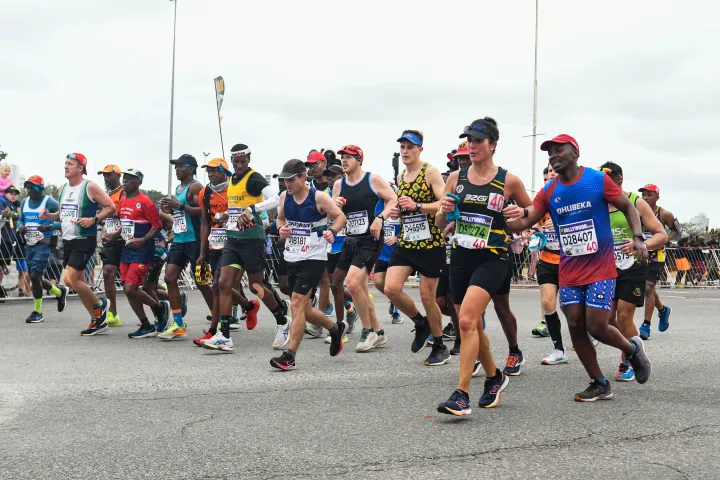

Following a protracted annual general meeting (AGM) at Carter High School in Pietermaritzburg on Saturday, the Comrades Marathon Association (CMA) has a new board.
Following the CMA’s first hybrid AGM of online and in-person attendees, seven board members with a diverse range of abilities were elected to serve the best interests of the annual ultramarathon and its wider community.
Attorney Mark Leathers, who has previously represented CMA members for free, won the most votes among the 14 candidates. He finished with a score of 278, with former top runner and New York Marathon winner Willie Mtolo coming in second with 254.
Mqondisi Ngcobo, the CMA’s most recent chairman, returned to the board after resigning in August after a period of intense public scrutiny, while human resources professional Brenda Marolen (founder and head of Urithi Athletics Club) was also supported by members.
EasyEquities’ chief marketing officer, Carel Nolte, as well as security specialist Rory Steyn and retired electrical engineer Alan Gray, were selected.
“The new board appears to be well-balanced, with both youthful talent and experience. At the end of the day, everything went smoothly, and we are pleased with our new board. We only want them to be successful and continue the history of the Comrades Marathon,” outgoing interim CMA chairperson Jeff Minnaar told The Witness.

The top five after Saturday’s voting will serve two-year terms, while the remaining two new board members (Steyn and Gray) will be given one-year terms each.
The newly elected members will serve alongside Isaac Ngwenya and Nontuthuko Mashimane on the board. The pair’s terms of office did not expire, therefore they were able to remain at the CMA’s top table.
On paper, the new board definitely inspires great confidence and possesses a diverse skill set, which may be key in turning around the public view of the CMA after a rocky few months.
Over the last few months, the CMA has faced claims of maladministration and prejudice. In reality, during the AGM, racing and operations manager Alain Dalais declared that the interim CMA board had launched an independent investigation into the allegations. A thorough report would be completed in roughly a fortnight.

If Ngwenya is found to be involved in any misconduct during the investigation, he will be forced to resign. He has repeatedly stated his innocence in any wrongdoing.
“Yes, there are allegations of corruption, but there’s no corruption on the board because all procurement is done through one system, and any payment is accounted for in the books,” Ngwenya remarked on August 20, 2024.
In addition to electing a new board, members of the AGM were asked to vote for or against a number of initiatives, including modifications to the CMA constitution.
One key resolution passed was for KwaZulu-Natal Athletics and Athletics South Africa’s (ASA) honorary seats on the CMA board to be non-voting in order to avoid the two entities from interfering with the organization’s operations.

Leathers, who proposed this motion, referenced the court case between KZN Athletics and CMA members to illustrate his point. The proposal passed with 87% of the vote.
Though a proposed constitutional change to remove KZN Athletics and ASA from the CMA board received the required number of votes (two-thirds majority), the motion’s approval sent a clear message to KZN Athletics and ASA that any interference from them would not be tolerated.
At the AGM, it was also resolved that no actively serving board member should have a portfolio position on the Race Organising Committee at the same time, which has previously been used to facilitate corruption.

Given how the Comrades have dominated the headlines in 2024, the board will face a difficult task in restoring the CMA’s reputation. The results of the ongoing probe will be critical to this.
However, they are scheduled to convene in the coming days to elect a new chairwoman. DM
About The Author

